
Thinking how we write stories about climate change. How did it get so complicated?

My BBC global podcast series, No Place but the Water, just dropped on Audible and I’m thinking again how difficult it is to write about climate change.
A couple of years ago, I asked my son what his favourite climate-change story was and he said ‘Interstellar’ by Christopher Nolan, which actually is kind of driven by climate change, but is essentially a story about the preciousness and loss of time and the consequences of that on a father and his daughter.
I asked my daughter about her favourite climate-change stories and she talked about the Voldemort effect. That everyone in Harry Potter up until Book 5 is in denial about his existence. She thought (she was 14 at the time) that was a powerful metaphor for how we are ‘ignoring’ climate change.
Wow.
Watching His Dark Materials on TV again recently, buried in Pullman’s writing is a very strong environmental idea that the price of obtaining dust, the most precious of all material, is the price of life. Not only to the children but to the different worlds that are all interconnected and sent into a melt-down when their borders are cut open.
All these are kind of hidden metaphors or seams in the work. Buried so deep in the stories are they even there at all? As writers can we kick stuff up closer to the surface? Should we be? What is a story for? What expectations do we have on a story to educate? Already the slippage in language between the poetic and the formal, the idea and the message becomes really tricky.
I hate ‘messages’ or ‘issue-based themes’ overwhelming a book or a film. It gives me the ick. Straight away the form fails and I’m bored. Have been known to run out of a theatre. Metaphor as in 'Don't look up,' also gets me feeling really twitchy.
Because writing is always the work of the imagination and when the form we use gets overloaded with the didactic, it refuses to come into being. Collapses into itself and spits the writer out, story and all. Then we’re in all kinds of trouble.
Maybe that’s why most climate change stories fail. Because they’re too worthy. Too preachy. Too trying to scare the shit out of us. A bit close to death, who can comprehend their own death, so forget the death of all the species we love – trees, ocean, penguins…
Then the overwhelm, followed by shut-down. Below is the bridge that inspired the crossover in Season Two of No Place.

So my starting point writing about climate-change is always a story. The capacity for the piece of work is to become itself. So the difficult question by extension can be how to embody that piece of work with questions and elements of climate change without deadening the impulse of the creative form, but not submerging it so much that it doesn’t register.
For me, sometimes it’s thinking about things I’ve lost. I love a list. So they often show up in my writing.
This is Birdie’s, in No Place but the Water. Set in a hotel at the end of the world. She’s thirteen (going on thirty) and distracting herself as she finds her way through a dark place to a forest.
My Lost List.
Odd socks. About a hundred.
Keys. House-key. Locker-key. Key to my bike.
Pencil case. Cases. Just always leaving them all over.
Aw, this pen that I loved. Fluffy top. Someone stole that.
My mind some days.
A cat we had called Cleo who went.
My house. My bike. My best friend called Stanley. Stan for short – girl, big teeth, big ideas. My pet rabbit, Steve. Made a getaway.
All the days I should be at school. Dreams. Wanted to be a vet, probs not clever enough and I don’t like blood by the way.
What else have I lost? TV shows. Teeth. Peace of mind. I don’t know. New shoes.
You know, trees are friendly. Don’t want to lose them. If you look at a tree, it’s almost like they look back at you. Can’t explain it. My nan said that trees go down as high as they go up and their roots are like networks and they’re all talking to each other.
I lost my Nan.
Never knew about dying.
I lost what her face looked like.
Sometimes making a lost list is a good experiment as a writer. To remove something from the world and examine what its absence does to the writing. Takes Birdie a while to get to her Nan on the list, but she is the lost thing that is the most real and difficult to think about.
So the loss of a colour, the breakdown of memory, an absent person, the disappearance of the sparrow, the selling of a house, the death of a tree, the loss of a coastline might integrate, appear, weave through, or work as an undercurrent in a new piece of climate writing. Helps to explore the interconnectedness between us and the world and all we are losing. Writing in our own particular way through the curl of a story, the sigh of a poem, the silence of a play and the stuff we’ve lost. In No Place the thing they first lose is their home. That’s how they end up at the Hotel at the End of the World right at the beginning.
But…
Actually, writing No Place I just really wanted to make people hope. I wrote the first and second series in Lockdown, my family was disintegrating. I was up to my neck in divorce, my lovely sister, Jane, was dying (we didn’t know that yet) and I wanted to celebrate (maybe hold onto) what a family looks like in its ridiculous hilarious devastating splendor – three generations altogether.
Funny. Absurd. Later tragic.
And I wanted to write about the bravery of young people (my kids were growing up fierce – the school-strikes were happening and it seemed like a moment until Covid got us). Also I wanted to write about the capacity for people with neuro-diverse brains to change the world (I think that was me).
But what writing climate always does, by definition, is to invite us to write about the natural world. The centre of No Place is the biggest, most ancient last Elm tree left standing. It’s magical. It transforms the whole family. It holds secrets and allows metamorphosis. It’s actually inspired by an enormous oak in North Yorkshire which is my tree of trees. A massive giant who may have seen a thousand years and hopefully will outlive us all.
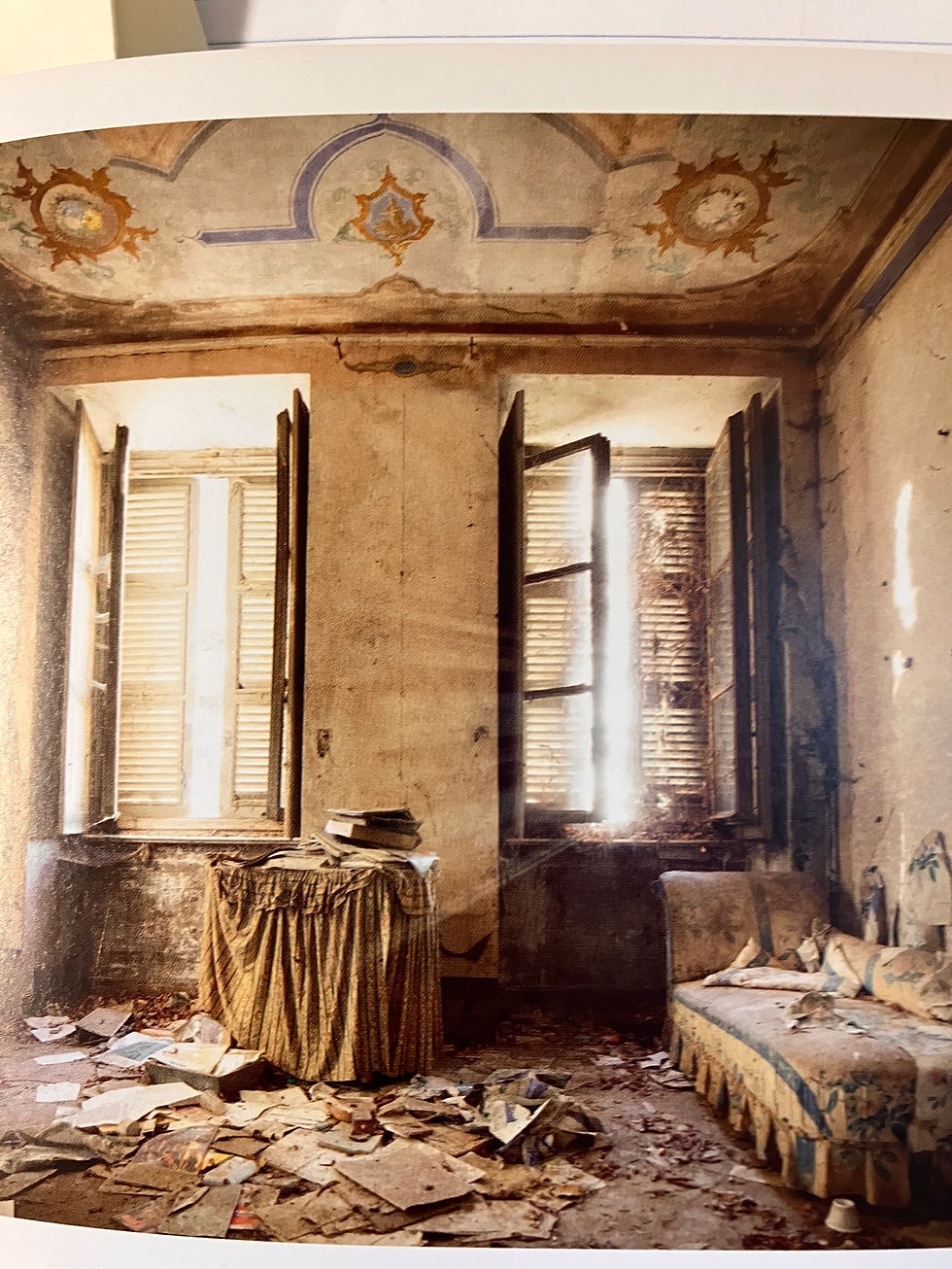
And meantimes, I wanted to write about scary hotels, because I’m mad for dead places, climbing through windows of ruins and going into ripped up worlds I’m not supposed to.
I wanted to write about flood because bringing my kids up in York and Hebden Bridge, I have seen rivers go over bridges and swallow towns. I have stood at the edge of a road half swilled with water, with two kids in a pushchair, wondering if I dare cross (I didn’t). I have seen water wash away towns; friends shops and homes. A caravan site gone.
But also, because I had written Series One and Two of No Place and really loved the brilliant actors in it – I told them after we recorded Series Two I was gonna kill a major character in Series Three. They all freaked out; terrified it would be them, so I decided I would have to go. Actually, it was one of the best writing rules I ever gave myself, because I had to make (just to wind them up when they read it) every character have a very close brush with death and it became actually a brilliant build with increasing peril. As Series Three goes on it gets more and more scary, until the two teenagers, boy and girl, Cal and Jessie, young love, riffing on Romeo and Juliet, two of the main characters, both have to face up to endings that we and they don’t want to.

It was the best writing challenge ever. So maybe, when writing about climate change, we have to challenge ourselves to be more playful. Rip up the rulebook. Not be so serious and worthy (of course, it is incredibly serious, but stories don’t necessarily bend to those rules).
My favourite climate-change film is the brilliant black comedy Icelandic movie, Woman at War. It has such a funny pop-up conceit in it (no spoilers), that continually repeats and just makes me roar with laughter. I think that’s the way forward for climate writing. Audacity. Pushing the form. Breaking rules. It is a wonderful film.
I am writing No Place but the Water currently as a YA novel, and to dive back into all those characters and the big journey they go on is a big kind of joy. And absence. A devastating loss. I guess that’s where sometimes we find the stories we’re looking for. I worry it's not serious enough. That the world I have created is much less brutal than what the world will look like if we don't stop heating the planet.

But, people still message me about it. A grandmother in the US who every time she gets in the car with her grandkids – they start from the beginning again. It’s the only thing I ever wrote that people have stopped me on the street about. So it’s still I hope, full of crazy, funny moments, and without giving too much away the trees make it to the end. Can’t tell you about everyone else. You’ll have to go listen.
No Place but the Water is on Audible now and Spotify and other platforms.
My tree of trees. This forgotten ancient oak in Yorksire is over 800 years old. It is the real giant that has inspired so much of my writing.

And still I ask myself can stories can change the world or are we just kidding ourselves, and all this is just happy nonsense?
Does writing climate change matter? And if so, can we get these stories out there if climate fiction does not sell? My answer is to keep writing, write better stories and illuminate this beautiful world we live in.


Comments